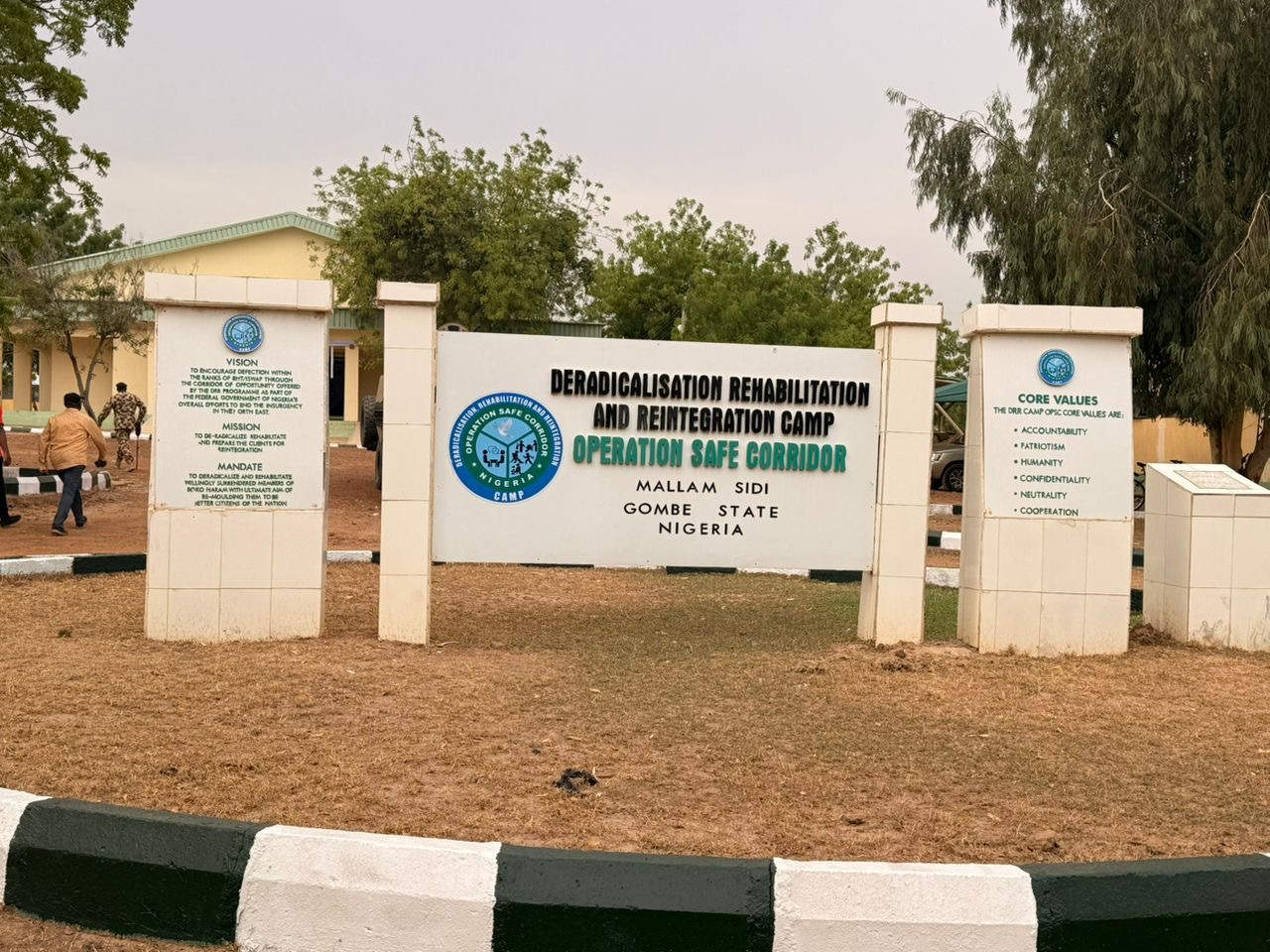

By Sarafina Christopher, News Agency of Nigeria (NAN)
In many communities across Nigeria’s North-East, the sound of gunfire has faded, but peace remains unfinished. Villages once emptied by violence are slowly rebuilding, markets have reopened in some areas, and families displaced for years are returning home.
Yet alongside reconstruction has come another difficult task: deciding how to live again with people who once moved within insurgent ranks or territories.
For residents in parts of Borno, Adamawa and Yobe states, reintegration is not an abstract policy debate. It is personal, emotional and often uneasy.
A traditional leader in Borno, who requested anonymity because of the sensitivity of the issue, said communities continue to carry the scars of conflict even as they are being asked to support reconciliation.
“We are playing a crucial role in supporting the reintegration of former insurgents and promoting peaceful coexistence.
“We create awareness in our communities and encourage them to welcome back those who have gone through the process.
“We engage the people to foster understanding and forgiveness. We manage conflict and promote peace,” he said.
But he also acknowledged persistent fears.
“We still worry that if they are not properly coordinated, some may return to the bush,” he said.
That tension between hope and anxiety lies at the centre of one of Nigeria’s most debated security initiatives: Operation Safe Corridor (OSC), the Federal Government’s deradicalisation, rehabilitation and reintegration programme for low-risk former associates of insurgent groups who voluntarily surrender.
As Nigeria continues to confront the long-term consequences of insurgency, policymakers have increasingly adopted non-kinetic strategies alongside military operations to address the drivers of violent extremism.
Supporters describe it as a pragmatic peacebuilding intervention that offers a pathway out of violence and helps weaken extremist networks from within. Critics question its safeguards, the adequacy of reintegration measures, and whether communities and victims are being asked to bear too much risk.
One claim widely circulated is that rehabilitated individuals are simply released into communities without proper screening or monitoring. Stakeholders say the reality is more complex.
According to Agha Omaka, Programmes Officer of Operation Safe Corridor, the programme begins with voluntary surrender, a distinction he says is central to its legal and operational framework.
“The journey of a client begins with voluntary surrender, and that distinction is very important,” he said.
He explained that those who surrender undergo screening and profiling by military and civilian intelligence agencies. Their identities, backgrounds, level of involvement and potential security concerns are assessed before any further step is taken.
“Operation Safe Corridor does not determine who enters the programme. Only those cleared through the legal process are recommended,” he said.
The legal process is overseen by the Federal Ministry of Justice, which determines eligibility and whether an individual should instead face prosecution or other security procedures.
Those admitted then move into a structured rehabilitation phase that includes psychosocial support, counselling, vocational training, religious reorientation and behavioural assessment. Participants are later handed over to state governments for reintegration into communities.
“They are not simply released. Reintegration is gradual and involves state authorities, traditional institutions, community structures and monitoring frameworks,” Omaka said.
Mr Dengiyefa Angalapu, Research Analyst at the Centre for Democracy and Development (CDD West Africa), said misinformation has shaped public perceptions of the initiative.
“One common misconception is that the military is recruiting ex-combatants into the Nigerian Army. That is virtually impossible considering the layers of recruitment screening and community attestation required,” he said.
Another misconception, he said, is that Operation Safe Corridor serves only perpetrators while victims are ignored.
“It is important to understand that Safe Corridor is one component within a wider institutional framework. Other agencies were expected to support victims, humanitarian recovery and reconstruction,” he said.
Angalapu noted that Operation Safe Corridor comprises multiple ministries, departments and agencies, each with distinct responsibilities ranging from rehabilitation and security screening to humanitarian support and public sensitisation.
According to him, public dissatisfaction may partly reflect uneven performance across that wider system rather than the deradicalisation component alone.
“For such a programme to work effectively, all participating institutions must do the work assigned to them. They should not remain nominal members,” he said.
He argued that one of the programme’s major weaknesses may be communication rather than secrecy.
“Many people do not understand how low-risk classification works or the role of the Joint Investigation Committee involving security agencies and the Ministry of Justice,” he said.
Even so, process explanations alone do not erase trauma.
In many affected communities, residents remember relatives killed, children abducted, farms abandoned and years spent in displacement camps. For survivors, the return of former associates of armed groups can reopen painful memories.
That is why some experts say reintegration must be matched by a stronger peacebuilding architecture.
The Director-General of the Institute for Peace and Conflict Resolution (IPCR), Dr Joseph Ochogwu, said programmes like Operation Safe Corridor reflect an important recognition that force alone cannot solve insurgency.
“The Nigerian government realised you cannot go all the way kinetic. There has to be a softer approach,” he said.
He described the initiative as commendable but argued that reconciliation must be treated as a core pillar rather than an afterthought.
“Peacebuilding requires expertise in confidence-building, reconciliatory processes and restoring trust,” he said.
According to him, several forms of reconciliation are necessary: between communities and returnees, between citizens and the state, and in some cases between civilians and security institutions operating in conflict areas.
“Reconciliation is not just bringing people back. It is asking: people have been wronged, so how do we move forward?” he said.
Security analyst Brig.-Gen. Yusuf Ali said non-kinetic approaches are strategically valuable because insurgency is sustained by more than battlefield strength.
“Insurgency is not sustained only by armed fighters on the battlefield. It is sustained by recruitment systems, fear structures, indoctrination, social dislocation and economic desperation,” he said.
He said one of the programme’s key achievements is creating a credible pathway for surrender.
“Once individuals begin to believe there is a lawful alternative to remaining in the bush, it reduces the aura of permanence around extremist groups,” he said.
But he cautioned that deradicalisation inside a facility is only one stage of a longer journey.
“If reintegration is poorly managed, the risks are significant. These include relapse into violence, reconstitution of networks, community backlash and loss of public trust,” he said.
For that reason, analysts say the true measure of Operation Safe Corridor begins after participants leave camp. Can they find work? Can they support families? Are communities prepared to receive them? Are victims receiving support of their own?
Programme officials say monitoring continues after reintegration through collaboration involving security agencies, community leaders and partners.
They also acknowledge challenges including funding gaps, misinformation, uneven state capacity and difficulties translating vocational training into stable livelihoods.
Questions also remain over long-term recidivism rates. While officials maintain that relapse is limited, analysts say more independent research would help strengthen public confidence and provide clearer evidence on long-term outcomes.
According to research by the Centre for Democracy and Development (CDD West Africa), more than 85 per cent of lower-level Boko Haram foot soldiers studied were forcibly conscripted, abducted or otherwise drawn into insurgent structures under coercive conditions, complicating assumptions that all returnees were hardened ideological actors.
Another unresolved issue is justice for victims.
For many survivors, seeing former associates receive training or structured reintegration can feel deeply unfair when they themselves still face displacement, poverty, grief or untreated trauma.
Angalapu said Nigeria needs a stronger victim-support architecture to balance reintegration with justice.
“No deradicalisation effort will command full legitimacy if victims feel forgotten,” he said.
That may be one of the most important lessons from the wider Operation Safe Corridor debate: rehabilitation of former associates and healing of victims cannot be treated as competing goals. Both are necessary pillars of sustainable peace.
Civil society organisations such as Neem Foundation and Search for Common Ground have also worked in psychosocial recovery, dialogue facilitation and community resilience, showing the wider role non-state actors can play in rebuilding trust after conflict.
The real question, therefore, is not whether deradicalisation alone can deliver lasting peace. It is whether Nigeria can build the broader justice, trust, opportunity and reconciliation systems without which no peace can endure.
Operation Safe Corridor may offer one pathway out of violence. But lasting peace will depend on what happens beyond the camp gates.
Leave a Reply